Southeast Asia’s markets reveal daily life, food culture, and local rhythms, making them worthy destinations rather than brief stops. (Image by oscarespinosa)
A wet market should never be a stop on the way to somewhere else. And yet on so many itineraries, that is exactly its role: wake early, wander the aisles, photograph a pyramid of rambutan, then move on to whatever museum or cafe was deemed important enough to anchor the day. Perhaps we have it the wrong way around.
Markets do not offer the effortless polish of attractions built for visitors, but that is exactly why they reward those willing to slow down. They tell you what is in season, what people are cooking at home that week, and which ingredients are worth selecting by hand rather than grabbing from a shelf. They show you how food arrives in a city long before it ever reaches a restaurant table.
Perhaps best of all, they resist the predictability of modern trends. There is no single stall everyone is elbowing toward, no famous order, no perfectly lit corner waiting for its close-up. The best thing to eat that morning might just be whatever was made well that morning, and the best recommendation might come from a vendor sending you three stalls down for someone else’s specialty entirely. So if you want to make the market the point rather than a box on the list, give it time. Let the market tell you where the rest of the morning goes.
TTDI Market: A Kuala Lumpur morning worth building around
If I were to choose one market in Kuala Lumpur to give an entire morning to, it would be Pasar Besar Taman Tun Dr Ismail, or TTDI Market as most of us know it. Perhaps I am biased but it has long been one of my favourite markets, partly because it offers exactly what I want from one: the serious business of grocery shopping alongside the equally serious business of deciding what to eat next. This isn’t somewhere to rush through before moving on; this can be the whole morning.
Start downstairs, where the wet market is doing what it has always done. Fish are cleaned to order, vegetables are piled high, and regulars move between stalls they’ve frequented for years. As one of Kuala Lumpur City Hall’s established indoor markets with 268 stalls, its appeal lies more in its quiet familiarity than its size. Take your time. Ask what is good that morning rather than arriving with a rigid shopping list. Look at the herbs, sauces, and regional ingredients. Even without a kitchen waiting for you, there is something satisfying about understanding what locals are buying for theirs.
Then comes my favourite part: eating. Breakfast here doesn’t require leaving the building, as food stalls have been woven into its upper floor for decades. Chanai & Chaya, run by a third generation since 1985, serves everything from appam and thosai to Sarawak laksa. Jenny Hong Soyavite provides fresh soya bean milk and tau fu fah, nestled alongside stalls serving pan mee, curry laksa, and traditional toast—all the kinds of breakfasts that invite you to sit, linger, and realise you aren’t quite finished.
That is the beauty of TTDI Market. Walk first, eat, go back downstairs for fruit, and notice which vendors greet customers by name. You begin to see the market as a vital piece of neighbourhood life: families trading for decades, people coming for fish, alterations, or a familiar morning routine. It was never a stop on a Kuala Lumpur itinerary. It was the itinerary.
Market etiquette: Go early, particularly if you want to see the wet market at its busiest and have the best choice of produce. Do not block the aisles while taking photographs, and always ask before photographing a vendor at close range. Let sellers handle produce unless they indicate otherwise, especially seafood and items that are being portioned to order. If someone takes the time to explain an ingredient or help you choose something, buying from them when practical is a small but meaningful courtesy. And upstairs, particularly during the breakfast rush, order before settling in and do not linger over a table when others are waiting.
TTDI may be my own benchmark for a market morning well spent, but it is far from the only one. Across Southeast Asia are markets that reward the same slower approach, where wandering, observing, and eating become the itinerary itself.
Tor Kor Market: Understanding Thailand through its produce
Bangkok’s Or Tor Kor Market is orderly and known for its carefully selected fresh produce and prepared Thai food. That polish makes it an accessible introduction to the country’s market culture, but it should not be mistaken for a place to rush through simply because it is easy to navigate.
Give yourself a morning to understand Thai seasonality through its fruit stalls alone. Mangosteen, pomelo, rambutan, longan, mango (!!!), and durian appear in different varieties and grades, with sellers who know which should be eaten immediately and which need another day.
Take a first lap without buying anything. This is your chance to take it all in and do a little reconnaissance. On the second, choose fruit with help from the vendor, then build a meal from the prepared-food stalls rather than attempting to order everything at once. Start with something savoury, pause, then return for coconut sweets or mango sticky rice.
The pleasure is not in collecting the highest number of dishes. It is in having enough time to notice why one mango costs more than another, or why a shopper passes several stalls before choosing her curry.
Market etiquette: Do not squeeze, peel or pick up fruit unless the seller invites you to. Prices for prepared food are generally not an invitation to bargain. When language is limited, greet the vendor first, point politely and confirm the quantity before the food is packed.
Geylang Serai Market: Where Singapore’s Malay food culture comes together
At Geylang Serai, the wet market and food centre belong to the same experience. The two-storey complex places the market below and cooked food above, within an area closely associated with Singapore’s Malay community. Its design draws from the form of a traditional Malay kampung house, while the market remains an important social and culinary centre for the surrounding neighbourhood.
Spend the first part of the morning downstairs. Look for fresh coconut, herbs, seafood, spices and the prepared ingredients that make home cooking more manageable. Notice how much labour has already taken place before anything reaches the stove: coconuts grated, fish cleaned, chillies blended, and vegetables trimmed.
Only then head upstairs to eat. Instead of treating the hawker centre as a separate breakfast stop, look for the connection between the two floors. The coconut you saw being prepared below may appear in a gravy or sweet. The spices stacked at one stall re-emerge in the rice, sambal or soup on your table.
This is how a market becomes more than a place to consume food. It becomes a way of understanding how a cuisine is assembled.
Market etiquette: Avoid lingering directly in front of a busy counter while deciding what to order. Observe how the queue works before joining it, have payment ready and clear your place according to the instructions displayed in the food centre. During peak periods, do not occupy a table longer than necessary.
Bình Tây Market: A window into Ho Chi Minh City’s trading networks
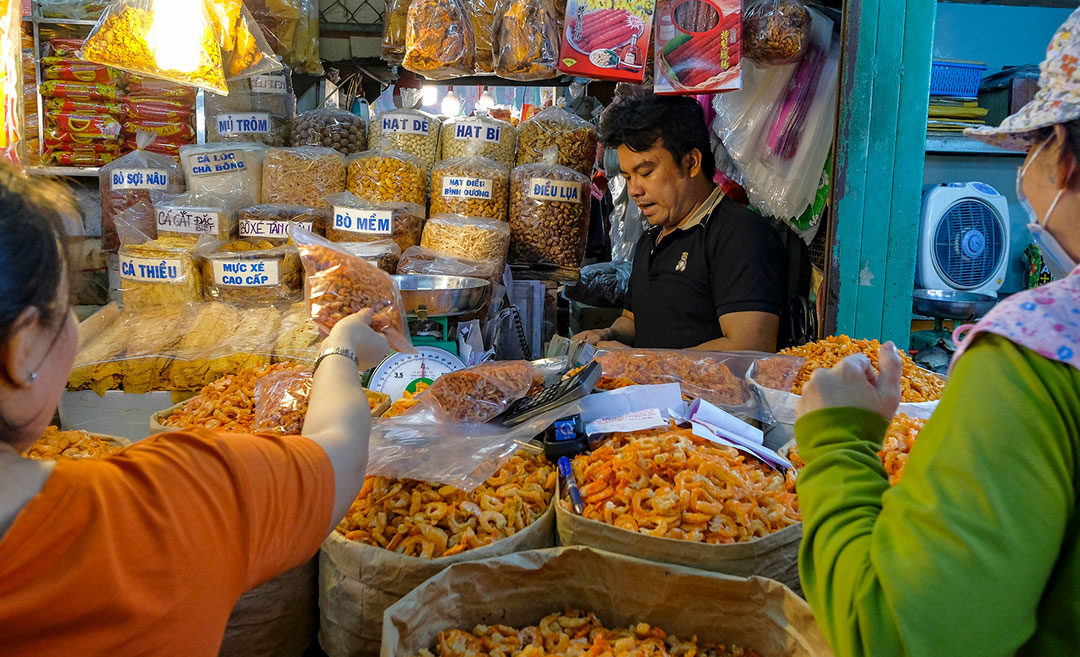
Bình Tây is not primarily arranged around what an individual traveller might like to buy. It is a wholesale trading centre in Chợ Lớn, Ho Chi Minh City’s Chinese quarter, with more than 2,000 shops selling products including spices, mushrooms and dried seafood. But that is precisely what makes it particularly rewarding when approached without a souvenir list.
Give the market time to reveal its scale. Look at how goods are packed, stored and moved. Notice the ingredients shared across Vietnamese and Chinese kitchens, the sacks and bundles intended for businesses, and the way an order is assembled for someone buying far more than a traveller could reasonably carry.
You may leave with coffee, dried fruit, spices, or packaged food, but shopping is not the only measure of the visit. The market offers something more interesting: a look at the trade that keeps restaurants, smaller markets and home kitchens supplied.
Eat when you find a stall serving something that suits the hour, then sit long enough to watch the market continue around you.
Market etiquette: Remember that many sellers are working with wholesale customers. Ask whether smaller quantities are available rather than expecting large packages to be opened. Carry small notes, confirm prices before purchasing and bargain only where it appears customary. Do not turn every transaction into a performance.
Pasar Beringharjo: Exploring Yogyakarta through food and batik
Pasar Beringharjo is often folded into a day along Malioboro, somewhere between shopping, heritage buildings and the Kraton. But the market has enough layers to hold a morning on its own.
It is closely tied to Yogyakarta’s commercial and cultural history, with a mix of colonial and traditional Javanese architectural influences. Today, visitors come for batik, traditional food, household goods and other market staples.
Begin with food rather than textiles. Try a Javanese snack, look through the spices and traditional ingredients, and pay attention to what local shoppers are taking home. Then move towards the batik sections once the market is fully awake.
Like the best markets, Beringharjo rewards visitors who allow curiosity rather than a shopping list to determine the pace of the morning.
Market etiquette: Bargain lightly and with good humour. Do not unfold piles of clothing or fabric without allowing the seller to assist, and do not leave a stall in disarray. Ask permission before photographing vendors or artisans, particularly at close range.
Carbon Market: Following Cebu’s daily rhythm
Carbon Market is better understood as part of Cebu’s daily rhythm than as a single attraction with a clear beginning and end. The long-standing market area sells fresh produce, ingredients and everyday goods, and remains closely connected to how the city shops and eats.
This is not somewhere to “cover” in 20 minutes. Give it a morning and allow the route to remain loose. Start with fruit or a warm snack, continue through the produce and dried-goods areas, then eat again when the market presents something worth stopping for.
Look for what is abundant rather than what appears exotic. Seasonal fruit, vegetables, dried fish, and ingredients used in Cebuano kitchens say more about the city than a list of foods selected purely for their novelty.
Market etiquette: Bring small notes and keep personal belongings secure without becoming visibly suspicious of everyone around you. Give way to workers carrying goods, avoid photographing people without asking and do not criticise smells, preparation methods, or unfamiliar ingredients within a vendor’s hearing.
Zafigo Pro Guide: Building a travel day around a market
If you want to make the market the point rather than a box on the list, give it time.
🍎 Do a full lap before buying anything: Resist the urge to stop at the first interesting stall. Walk the market once to understand its rhythm, busiest corners, and specialities.
🍎 Follow local curiosity, not internet recommendations: Instead of hunting for a famous vendor, ask what is particularly good that morning or notice where locals are queuing.
🍎 Buy from the people who share their knowledge: If a vendor takes time to explain an ingredient or make a recommendation, support them if you can.
🍎 Let food decisions happen gradually: Rather than ordering everything at once, eat slowly, wander, then return for something else.
🍎 Remember that markets are workplaces: Stay aware of foot traffic, ask before taking photographs, and avoid treating everyday routines as performances.
🍎 Allow the market to rewrite your plans: If breakfast becomes lunch or a conversation sends you elsewhere in the neighbourhood, follow it.